
SQL ONLINE COURSE WITH A CERTIFICATE
SQL Courses
SQL courses teach a language designed for working with databases. Learn the fundamentals, such as querying data, database design, and data manipulation. SQL is crucial for database administration, data analysis, and backend development.
What you will learn:
- SQL Basics and Advanced Concepts
- How to use SQL for data analysis
- Job-oriented SQL skills for data analysis
- Essential skills needed to secure a job as a SQL Developer
Benefits of an SQL Certificate:
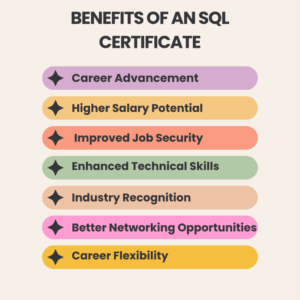
- Improve your chances of securing a job in SQL development.
- Distinguish yourself from other candidates.
- The certificate verifies your mastery of the fundamental skills in SQL development, fostering trust with potential employers.
- Highlight your skills on your resume, LinkedIn, and other social media platforms.
- Increase your appeal in the job market.
SQL Key Features:
- Covers SQL concepts from basic to advanced levels.
- Includes dedicated live sessions led by industry experts.
- Offers self-paced learning modules so you can study at your convenience.
- Features hands-on projects to apply skills to real-world scenarios.
- Provides an engaging learning experience with demo sessions and real-world examples.
- Upon completion, you will receive an industry-recognized certificate.
Who Should Consider Getting Certified?
Getting certified can be beneficial for a wide range of individuals, depending on their career goals, industry, and professional development aspirations.
Learn more about SQL
Enroll in an SQL course at Maria Academy and discover how to build, analyze, and restore various databases. SQL is one of the most widely used programming languages globally, essential for designing the databases that many applications rely on. As a result, SQL skills are highly sought after by employers. Learn from industry experts about the growing importance of data in today’s business world. Prepare to enhance your resume by adding SQL to your skill set!
Course Content
Module 1: Introduction to Databases & SQL
- Overview of Databases
- What is SQL?
- Types of Databases: RDBMS vs. NoSQL
- SQL vs. Other Query Languages
- Popular SQL Databases (MySQL, PostgreSQL, SQL Server, SQLite, Oracle)
Module 2: SQL Basics & Database Management
- Introduction to Tables, Rows, and Columns
- Creating a Database (CREATE DATABASE)
- Deleting a Database (DROP DATABASE)
- Creating Tables (CREATE TABLE)
- Modifying Table Structure (ALTER TABLE)
- Dropping Tables (DROP TABLE)
Module 3: Data Manipulation (DML)
- Inserting Data (INSERT INTO)
- Updating Data (UPDATE)
- Deleting Data (DELETE)
- Retrieving Data (SELECT)
Module 4: Filtering & Sorting Data
- Filtering Data with WHERE Clause
- Using Operators (BETWEEN, IN, LIKE, AND, OR, NOT)
- Sorting Results (ORDER BY)
- Limiting Results (LIMIT, OFFSET)
- Using Aliases (AS)
Module 5: Aggregate Functions & Grouping
- Aggregate Functions (COUNT, SUM, AVG, MIN, MAX)
- Grouping Data (GROUP BY)
- Filtering Grouped Data (HAVING)
Module 6: Working with Joins
- Understanding Database Relationships
- Types of Joins:
- INNER JOIN
- LEFT JOIN
- RIGHT JOIN
- FULL JOIN
- SELF JOIN
- CROSS JOIN
Module 7: Subqueries & Nested Queries
- Subqueries in SELECT, FROM, WHERE
- Correlated Subqueries
- Common Table Expressions (CTEs)
Module 8: Constraints & Indexing
- Primary Key & Foreign Key
- Unique & Not Null Constraints
- Default Constraints
- Indexing Basics (CREATE INDEX, DROP INDEX)
- Clustered vs. Non-Clustered Indexes
Module 9: Views & Stored Procedures
- Creating & Using Views (CREATE VIEW)
- Modifying Views (ALTER VIEW, DROP VIEW)
- Introduction to Stored Procedures (CREATE PROCEDURE)
- Creating and Executing Functions (CREATE FUNCTION)
- Understanding Triggers (CREATE TRIGGER)
Module 10: Transactions & Concurrency Control
- Introduction to Transactions
- COMMIT, ROLLBACK, and SAVEPOINT
- ACID Properties of Transactions
- Locking Mechanisms (LOCK TABLE, UNLOCK TABLE)
- Deadlocks & Concurrency Control
Module 11: Advanced SQL & Performance Optimization
- Query Optimization Techniques
- Using Execution Plans
- Indexing Strategies for Performance Improvement
- Avoiding Common SQL Mistakes
- Partitioning & Sharding for Large Databases
Module 12: SQL for Data Analysis & Business Intelligence
- Writing Complex Queries for Analytics
- Using SQL with BI Tools (Power BI, Tableau)
- Window Functions (RANK(), DENSE_RANK(), ROW_NUMBER())
- Case Statements & Conditional Expressions
Module 13: SQL and NoSQL (Optional Advanced Topic)
- Difference Between SQL and NoSQL
- Storing and Querying JSON Data
- Working with XML in SQL
Why Join this Program :
Develop Skills for Real Career Growth
Our cutting-edge curriculum is designed in collaboration with industry leaders and academic experts to help you acquire job-ready skills.
Learn from Experts in the Field
Our instructors are active professionals who bring current best practices and case studies to the classroom, ensuring that the training fits seamlessly into your work schedule.
Gain Practical Experience by Solving Real-World Problems
Engage in capstone projects that utilize real-world data sets and participate in virtual labs for hands-on learning experiences.
Receive Structured Support to Ensure Continuous Learning
Our 24/7 learning support offers guidance from mentors and a community of like-minded peers, helping you to resolve any conceptual doubts that arise.
SQL Certification Training FAQs
- What is SQL Certification?
An SQL certification is a credential that verifies your knowledge and skills in Structured Query Language (SQL), which is used to manage and manipulate databases. SQL certifications are offered by various organizations and tech companies to help individuals demonstrate their expertise in database management, querying, and optimization.
- What skills can I acquire from SQL courses at Maria Academy?
The SQL courses at Maria Academy provide learners with essential skills in database management and querying, including:i) Basic to advanced SQL commands for data retrieval, insertion, updating, and deletionii) Techniques for designing and managing relational databasesiii) Skills in writing complex queries to analyze and manipulate dataiv) Understanding of database optimization and performance tuning
v)Application of SQL in data science for querying large datasets
vi)Integration of SQL with other data analysis tools and programming language.
- What is SQL Server?
SQL Server is a relational database management system (RDBMS) developed by Microsoft. It is designed to store and retrieve data as requested by other software applications, making it a popular choice for efficiently managing and organizing large amounts of data. SQL Server supports Structured Query Language (SQL), which is the standard language used for managing relational databases. It offers a variety of features, including data storage, data integrity, security, transaction management, and high availability. SQL Server is widely utilized by businesses, organizations, and institutions for data-driven applications and analytics.
- What jobs demand you learn SQL?
There are several jobs that require you to learn SQL, including:i) Database Administratorii)Big Data Analystiii)Data Scientistiv) Systems Analyst
v) Business Analyst
vi) Software Developer
- What are the 5 types of SQL?
SQL commands are essential for effective database management. These commands are categorized into Data Definition Language (DDL), Data Manipulation Language (DML), Data Control Language (DCL), Data Query Language (DQL), and Transaction Control Language (TCL).
Social tagging: free online sql course certification > online certificationn sql > online sql course certification
Recent Posts
- Banking Sector: Tackling Security and Data Integrity Challenges with .NET Skills
- How Data Analytics Helps Manufacturers in Bangalore Reduce Production Downtime
- Understanding ASP.NET MVC Architecture with Real Examples
- Common Challenges in Learning Programming and How Python Makes It Easier
- Why Companies Are Hiring More React Developers Than Ever Before
Categories
- All
- Angularjs training in Chennai
- ASP.NET Core
- Data Analytics
- Dot Net Development Course
- dot net training
- dot net training in chennai
- dotnet full stack developer
- Free dotnet training
- information on dotnet
- Learn Java in chennai
- Learn Python at Karaikudi
- learn python online
- learn python online from chennai
- Linq Queries in .net
- mutual funds
- MVC Training Tutorials
- PHP Training in Chennai
- pmp training online
- power apps online training
- Power platofrm
- Python Training Online
- React Full Stack Development
- React training
- ReactJs
- share market
- Sharepoint framework online training
- SharePoint Freelancers in Chennai
- software testing
- spfx online training
- SQL Course Details
- Stock market
- Uncategorized