
Free SQL Course
Structured Query Language (SQL) is an essential skill for anyone working with databases. Whether you’re a beginner or looking to enhance your database knowledge, this free SQL course will provide you with the foundational skills needed to interact with databases efficiently.
Why Learn SQL
SQL is the standard language for managing and manipulating databases. It is used across various industries, including technology, finance, healthcare, and more. Mastering SQL can open doors to numerous career opportunities, such as database administration, data analysis, and backend development.
Benefits of Learning SQL:
- High Demand Skill: Many companies require SQL expertise for data-driven decision-making.
- Easy to Learn: SQL syntax is straightforward and resembles natural language.
- Universal Application: Works with various database management systems (DBMS) like MySQL, PostgreSQL, SQL Server, and SQLite.
- Career Growth: Opens opportunities in data science, business intelligence, and software development.
Why Use SQL :
- SQL allows users to access data in relational database management systems.
- It enables users to describe and define the data within the database, as well as manipulate that data effectively.
- Additionally, SQL can be embedded within other programming languages using SQL modules, libraries, and pre-compilers.
- Users have the capability to create and drop databases and tables, along with creating views, stored procedures, and functions.
- Moreover, SQL allows users to set permissions on tables, procedures, and views, ensuring proper access control.
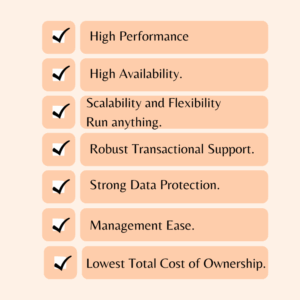
Features of SQL :
Grow Your Skills with Us
We’re excited to offer this course as part of a variety of programs. When you sign up, you’ll get to pick a program that suits you best!
- Discover new ideas with guidance from industry experts.
- Build a solid understanding of different subjects or tools.
- Enhance your job skills with fun, hands-on projects.
- Earn a career certificate you can proudly share!
Free SQL Course Platforms
You can find free SQL courses on:
- Khan Academy (Introduction to SQL)
- W3Schools (Interactive SQL Tutorial)
- Mode Analytics SQL Tutorial
- SQLZoo (Interactive SQL Practice)
- Coursera (Audit Option) (University Courses)
- Udacity (Intro to Relational Databases)
- Code-Academy (Basic SQL Track Free Version)
Advantages of SQL:
SQL (Structured Query Language) is widely used for managing and manipulating relational databases.
Easy to Learn and Use
- SQL uses simple English-like commands (e.g., SELECT, INSERT, UPDATE, DELETE), making it beginner-friendly.
Standardized Language
- SQL is a widely adopted standard supported by most database management systems (DBMS) like MySQL, PostgreSQL, SQL Server, and Oracle.
High Performance
- SQL databases are optimized for speed and scalability, handling complex queries and large volumes of data efficiently.
Scalability
- SQL databases can handle vast amounts of data and are scalable for growing business needs.
Integration with Programming Languages
- SQL can be integrated with various programming languages like Python, Java, PHP, and C# for seamless application development.
Frequently asked questions about SQL
- What is the primary key in SQL?
A primary key is a unique identifier for each record in a table. It ensures that every row in the table contains a distinct and non-null value in the primary key column. Primary keys are essential for enforcing data integrity and establishing relationships between tables.
- What is a constraint in SQL? Name a few.
A constraint in SQL is a crucial rule that governs the data in a table, ensuring that the information remains accurate and reliable. Among the most essential constraints are:– PRIMARY KEY: This guarantees that every value in a designated column is unique, eliminating duplicates.
– FOREIGN KEY: This maintains referential integrity, connecting tables and ensuring consistent relationships between them.
– UNIQUE: This constraint safeguards against duplicate values in a column, promoting data integrity.
– CHECK: This specifies conditions that data must be fulfilled before insertion or updates, enhancing data validation.
– NOT NULL: This ensures that crucial columns cannot contain NULL values, promoting completeness of data.
- What is the view in SQL?
In SQL, a view is a virtual table that is derived from the result set of an SQL statement. A view consists of rows and columns similar to a real table. The fields in a view are taken from one or more actual tables within the database.
- What is the trigger in SQL?
A trigger in SQL is a predefined sequence of actions that automatically execute when a specific event occurs, such as when an INSERT or DELETE operation is performed on a table. Triggers are used to ensure data consistency, conduct auditing, and simplify various tasks.
- What are aggregate functions? Can you name a few?
Aggregate function in SQL performs calculations on a set of values and return a single result.- MIN() – returns the smallest value within the selected column.
- MAX() – returns the largest value within the selected column.
- COUNT() – returns the number of rows in a set.
- SUM() – returns the total sum of a numerical column.
- AVG() – returns the average value of a numerical column.
Conclusion:
This free SQL course provides a structured learning path to help you gain proficiency in SQL. By following along with the modules and practicing regularly, you’ll be able to master SQL and apply it effectively in various fields like data analysis, software development, and database administration.
LEARN SQL ONLINE
Join this SQL course to master the skills needed to effectively manage large datasets and perform insightful data analysis using the industry-standard data management language. Don’t miss out on the opportunity to enhance your expertise!
About This Course
Information is everywhere, and you can harness its power by learning the basics of SQL. SQL is used in data science, analytics, and engineering, making it easy to work with data and to make informed decisions regarding strategy, operations, and business. This skill is beneficial for anyone who interacts with data, even in non-technical roles. In this SQL course, you will learn how to manage large datasets and analyze real-world data.
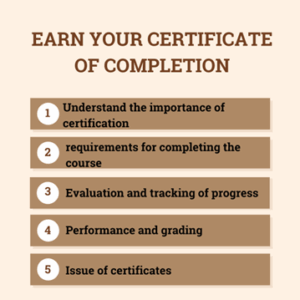
Earn Your Certificate of Completion
Show your dedication by earning a certificate for every course or learning path you successfully finish.
Validate Your Achievement
Receive a prestigious certificate that confirms your hard work and completion of the course or path.
Accumulate Your Success
With each course and learning path you conquer, you’ll build a valuable collection of certificates.
Promote Your Accomplishments
Easily display your certificates on your LinkedIn profile to enhance your professional image and showcase your achievements.
What you’ll learn
- To filter, sort, and summarize data, use SQL queries. You may also edit dates, strings, and numerical data from various sources for analysis.
- Assess and create datasets to address your business questions and challenges using SQL.
- Use the collaborative Databricks workspace to create an end-to-end pipeline that reads data, transforms it, and saves the results.
- Craft a compelling project proposal, carefully select relevant data, conduct thorough statistical analysis, establish clear metrics, effectively present your findings, and provide actionable recommendations. This process will ensure impactful results and informed decision-making.
Description:
SQL (Structured Query Language) is a standard programming language used to manage and manipulate relational databases. Learning SQL online provides hands-on experience in writing queries, retrieving and modifying data, and managing database structures. It is essential for database administrators, data analysts, software developers, and business intelligence professionals.
Key Highlights:
- Gain a strong foundation in essential SQL concepts, starting from scratch.
- Unlock advanced SQL techniques to tackle complex data analysis with confidence.
- Discover the principles of database design, normalization, and indexing to enhance your skill set.
- Engage with real-world datasets to develop practical problem-solving abilities.
- Learn to optimize your queries for improved speed and superior performance.
Key Topics Covered:
Introduction to SQL
- What is SQL?
- Importance of SQL in databases
- Relational Database Management Systems (RDBMS)
SQL Basics
- Data types and constraints
- Creating and managing databases
- Creating and modifying tables (CREATE, ALTER, DROP)
Data Querying with SQL
- SELECT statement for data retrieval
- Filtering data using WHERE
- Sorting results with ORDER BY
- Using DISTINCT to remove duplicates
Advanced Querying
- Aggregation functions (COUNT, SUM, AVG, MAX, MIN)
- Grouping data with GROUP BY
- Filtering groups using HAVING
- Joining tables (INNER JOIN, LEFT JOIN, RIGHT JOIN, FULL JOIN)
Data Manipulation
- Inserting data (INSERT INTO)
- Updating existing records (UPDATE)
- Deleting data (DELETE)
- Transaction control (COMMIT, ROLLBACK, SAVEPOINT)
Working with Subqueries and Views
- Using subqueries for complex queries
- Creating and managing views
Indexes and Optimization
- Understanding indexes for performance improvement
- Optimizing SQL queries
Stored Procedures and Functions
- Writing stored procedures
- Using functions for reusable logic
User Access and Security
- Managing database users and roles
- Granting and revoking privileges
Advanced Topics (Optional)
NoSQL vs SQL databases
Using SQL with big data
SQL in cloud databases (AWS, Azure, Google Cloud)
Frequently asked questions (FAQ):
- What are the benefits of an online SQL course?
This SQL certification course provides you with all the knowledge necessary to effectively work with SQL databases and integrate them into your applications. You will learn how to properly structure your database, write efficient SQL statements and clauses, and manage your SQL database to support scalable growth.
- How do I start learning SQL?
To begin learning SQL, start by setting clear goals for what you want to achieve. Next, find a reliable resource or course that suits your learning style. Finally, make sure to practice regularly to enhance your skills effectively.
- What is the best way to learn SQL?
SQL closely resembles the English language, making it relatively easy to learn independently. You can quickly pick up the basics by following online tutorials that cover the syntax and key concepts of the language. However, to become proficient in SQL, it is essential to practice regularly and work with data. Many people find it beneficial to learn tshrough tutorials, courses, or certification programs. These methods often include structured exercises and assignments that allow you to practice the skills you are acquiring, which can significantly accelerate your learning process.
- Is SQL in demand in 2025?
Since SQL provides the foundation for the effective administration and use of data in a variety of applications and sectors, proficiency with it is essential for machine learning engineers, data scientists, data engineers, data analysts, and software developers.
- What does SQL do?
SQL is a powerful tool that empowers users to access and retrieve valuable data from databases. It is essential for data scientists and analysts, allowing them to efficiently gather and prepare data for insightful analysis and impactful visualization. Moreover, marketers can leverage SQL to uncover how different types of content resonate with their audience, driving more effective strategies and enhancing engagement.
Who This Course Is For:
- Aspiring beginners eager to dive into SQL and database management from square one.
- Data analysts and scientists wanting to elevate their skills in data querying and analysis.
- Software developers aimed at seamlessly integrating database functionality into their applications.
- Business professionals seeking to harness data for impactful decision-making.
- Students and academics desiring a strong foundation and advanced expertise in SQL for academic projects and research.
- IT professionals dedicated to mastering database management and optimization.
- Career changers ready to embrace exciting opportunities in data-related fields or database administration.
- Anyone enthusiastic about mastering SQL and PostgreSQL for both personal enrichment and professional advancement.
We do it for you
Give us a try and join 1000+ happy students
Reviews


Microsoft SQL Server Certification
SQL Server Certification :
- SQL Server certifications provide a structured method to validate expertise, addressing various roles such as database administration, development, and business intelligence.
- SQL Server certifications are for all levels of experience in database management and data analysis.
- These certifications show that you have the skills to manage SQL Server environments.
- Earning a certification helps you prove your abilities to employers and coworkers.
Why Pursue SQL Server Certification:
Pursuing an SQL Server Certification can be highly beneficial for career growth, skill development, and job opportunities.
Professional Growth
- Higher Salary Potential – Certified professionals often earn more than non-certified peers.
- Better Job Opportunities – SQL skills are in demand for roles like Database Administrator (DBA), Data Analyst, Data Engineer, and Software Developer.
Industry Recognition
- Global Recognition – Microsoft certifications are widely respected in the IT industry.
- Validation of Expertise – Demonstrates your knowledge of SQL database management, security, performance tuning, and cloud integration.
High Demand for SQL Knowledge
- SQL is used in almost every industry, including finance, healthcare, retail, and tech.
- Many companies rely on Microsoft SQL Server, Azure SQL, and other relational databases for their operations.
Practical Education & Skill Development
- Certification training covers database security, optimization, automation, and troubleshooting.
- Prepares you for real-world challenges with practical labs and case studies.
Competitive Benefits
- Help you stand out from other candidates in job applications and promotions.
- Demonstrates commitment to learning and professional growth.
Pathway to Advanced Certifications
SQL Server certification can be a steppingstone to more advanced IT credentials, such as:
- Microsoft Certified: Azure Data Engineer Associate (DP-203)
- Microsoft Certified: Azure Solutions Architect Expert
SQL Server Certification Paths:
Microsoft offers a variety of SQL Server certification paths tailored to different IT roles and specializations.
These certifications allow professionals to validate their expertise in key areas such as Database Administration, Database Development, and Business Intelligence Development.
Selecting the appropriate certification path is essential for aligning with your career goals and fostering professional growth.
Certification Paths
Administration of databases: This path is ideal for professionals responsible for installing, maintaining, configuring, and securing database systems. Certifications in this category validate the skills necessary to ensure that database systems are efficient, secure, and highly available.
Development of databases: Designed for individuals who create and manage database solutions, this certification path assesses proficiency in designing database structures, defining data types, and implementing stored procedures, functions, and views.
Developing Business Intelligence: Targeted at professionals specializing in data analysis to support business decision-making, this path covers skills in implementing data models, developing reports, and designing dashboards.
Selecting the Right SQL Certification for Your Career
Boost Your Career with a Certificate
- Earning a certificate is a powerful statement of your commitment to skill enhancement.
- You can list this certificate as a credential on your CV, resume, LinkedIn profile, and other professional platforms.
- It provides you with the credibility needed for increased responsibilities, larger projects, and higher salaries.
- In today’s competitive job market, knowledge is power.
- Documenting your skills not only helps you advance in your current career but also enables you to pursue new opportunities.
Pros and Cons of SQL
SQL (Structured Query Language) is widely used for managing relational databases.
Pros of SQL:
Easy to Learn and Use
- SQL uses simple and readable syntax (e.g., SELECT * FROM table_name;), making it accessible for beginners and professionals.
Powerful and Efficient
- SQL allows complex queries to retrieve, manipulate, and manage large amounts of data efficiently.
Data Integrity and Security
- SQL databases support constraints (e.g., PRIMARY KEY, FOREIGN KEY, UNIQUE, NOT NULL) that enforce data integrity.
Cons of SQL:
Scalability Limitations
- Traditional SQL databases struggle with horizontal scaling (adding more servers) compared to NoSQL databases like MongoDB.
Expensive for Enterprise Solutions
- Some SQL-based systems (e.g., Oracle, SQL Server) require costly licensing and maintenance.
Performance Issues with Large Joins
- Complex queries with multiple joins can slow down performance if not optimized properly.
Frequently asked questions (FAQ)
- What is a subquery?
A SQL subquery, also referred to as a nested query or inner query, is a query that exists within another SQL statement. It enables you to use the result of one query as input for another query. Subqueries are enclosed in parentheses and can be employed in various parts of a SQL statement, including the SELECT, FROM, and WHERE clauses.
- What are indexes and types?
Indexing is a valuable technique that optimizes search times in database queries. The structure of database indexing includes a search key and a pointer. There are four types of indexing: Primary, Secondary, Clustering, and Multivalued Indexing. Primary indexing itself is divided into two categories: dense indexing and sparse indexing.
- What is the difference between a function and a stored procedure?
Triggers are unique stored procedures that run automatically in response to database events; functions are named operations that return a single value or a table; and stored procedures are reusable sets of SQL statements that can accept arguments and produce results.
- What is the primary key in SQL?
Each row in a table is usually uniquely identified by values contained in a column or combination of columns. The table’s entity integrity is maintained by this column, or columns, which are referred to as the primary key (PK).
- List the different types of relationships in SQL.?
There are three types of relationships between the data you are likely to encounter at this stage in the design: one-to-one, one-to-many, and many-to-many. To be able to identify these relationships, you need to examine the data and have an understanding of what business rules apply to the data and tables.
SQL Certification
SQL Certification:
An SQL certification is a credential that proves your proficiency in Structured Query Language (SQL), which is used for managing and querying databases. These certifications are offered by various organizations, they assess abilities in writing SQL queries and managing databases effectively.
Purpose of SQL Certification

- Validates SQL Skills: Shows that you have knowledge of SQL syntax, database management, and data manipulation.
- Improves Job Prospects: Helps in landing roles such as Data Analyst, Database Administrator (DBA), Software Engineer, and more.
- Enhances Career Growth: Employers often prefer certified professionals for specialized database roles.
- Boosts Confidence: Structured learning and certification ensure you have a strong foundation in SQL
How to Get SQL Certified :
- Choose a Certification – Decide between vendor-specific (Microsoft, Oracle) or general SQL certifications.
- Learn SQL Basics – Understand SQL syntax, queries, joins, and database management.
- Practice with Real Databases – Use MySQL, PostgreSQL, SQL Server, or Oracle for hands-on experience.
- Pass the Exam – Most certifications require you to take a proctored exam (online or in-person).
- Get Certified & Showcase It – Add the certification to your resume and LinkedIn profile.
What You Will Learn in SQL :
SQL (Structured Query Language) is used for managing and manipulating databases. You will learn:
- How to create, modify, and manage databases
- Writing SQL queries to retrieve and update data
- Optimizing database performance
- Using joins, subqueries, and indexing
- Implementing security and user permissions
Key Topics Covered
- Introduction to Databases & SQL
- Basic SQL Queries (SELECT, INSERT, UPDATE, DELETE)
- Filtering Data (WHERE, ORDER BY, GROUP BY, HAVING)
- Joins and Relationships (INNER JOIN, LEFT JOIN, RIGHT JOIN, FULL JOIN)
- Subqueries and Nested Queries
- Database Normalization & Constraints
- Indexing and Performance Optimization
- Stored Procedures and Functions
- Database Security and User Management
- Advanced SQL Features (Views, Triggers, Transactions).
Description
SQL is a crucial skill for data analysts, software developers, and database administrators.
This course will teach you how to interact with databases efficiently.
You’ll start with basic queries and move to advanced database management concepts.
By the end, you’ll be able to work with real-world databases, optimize performance, and ensure data security.
Frequently Asked Questions
- What is SQL and why is it important for data analysis?
SQL (Structured Query Language) is a programming language used to manage and manipulate relational databases. It allows users to retrieve, update, insert, and delete data stored in structured formats.i) Efficient Data Retrieval – SQL enables analysts to extract specific data from large databases quickly using queries.
ii) Data Manipulation – Analysts can filter, sort, aggregate, and transform raw data for better insights.
iii)Scalability – SQL works well with large datasets, making it useful for enterprise-level data analysis.
iv)Data Integrity – Ensures accuracy and consistency of data using constraints and relationships.
v)Integration with BI Tools – Many analytics and business intelligence tools (e.g., Tableau, Power BI) rely on SQL for querying databases.
vi)Automation – SQL scripts can automate data reporting and ETL (Extract, Transform, Load) processes.
vii)Cross-Platform Compatibility – SQL works with various database management systems (e.g., MySQL, PostgreSQL, SQL Server, Oracle).
- What are the benefits of SQL in data analysis?
SQL allows users to efficiently create, read, update, and delete records in databases. Its widespread use is partly due to its versatility, ease of understanding, and robust functionality, which facilitates precise management of large data sets.
- what is SQL used for?
Structured Query Language (SQL) is a powerful programming language designed for efficiently storing and processing information in relational databases. By organizing data in a clear tabular format, with rows and columns representing distinct data attributes and their interconnections, SQL enables users to manage and retrieve valuable insights from their data seamlessly. Embracing SQL can significantly enhance your ability to unlock the potential of your data.
- Is SQL a good career path?
SQL (Structured Query Language) is an essential skill in data management, making it a must-have for anyone pursuing a career in data processing or analysis. This guide presents a strategic roadmap for professional growth in SQL-related fields, highlighting the critical roles and skills required to elevate your career from a novice to a seasoned expert. Embrace the opportunity to enhance your expertise and open doors to new possibilities in data management.
- What is the best career path for a SQL Developer?
The most promising career paths for database developers specializing in SQL encompass a variety of roles that leverage their expertise in database management and data analysis. Key positions include:i) Data Engineer: Responsible for designing, building, and maintaining the data architecture and infrastructure necessary for data collection and processing.
ii) Data Administrator: Focuses on managing and maintaining database systems, ensuring their efficiency, security, and availability for users within an organization.
iii) Data Scientist: Utilizes statistical methods and machine learning techniques to analyze and interpret complex data sets, often to inform business decisions and strategies.
iv)Data Analyst: Analyzes data to extract actionable insights, create reports, and support data-driven decision-making processes within the organization.
v)Business Intelligence Developer: Develops and manages the technology and tools needed to transform data into actionable intelligence, often using data visualization techniques to present findings.
SQL ONLINE COURSE WITH A CERTIFICATE
SQL Courses
SQL courses teach a language designed for working with databases. Learn the fundamentals, such as querying data, database design, and data manipulation. SQL is crucial for database administration, data analysis, and backend development.
What you will learn:
- SQL Basics and Advanced Concepts
- How to use SQL for data analysis
- Job-oriented SQL skills for data analysis
- Essential skills needed to secure a job as a SQL Developer
Benefits of an SQL Certificate:
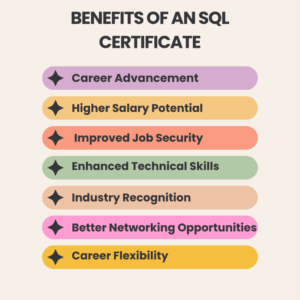
- Improve your chances of securing a job in SQL development.
- Distinguish yourself from other candidates.
- The certificate verifies your mastery of the fundamental skills in SQL development, fostering trust with potential employers.
- Highlight your skills on your resume, LinkedIn, and other social media platforms.
- Increase your appeal in the job market.
SQL Key Features:
- Covers SQL concepts from basic to advanced levels.
- Includes dedicated live sessions led by industry experts.
- Offers self-paced learning modules so you can study at your convenience.
- Features hands-on projects to apply skills to real-world scenarios.
- Provides an engaging learning experience with demo sessions and real-world examples.
- Upon completion, you will receive an industry-recognized certificate.
Who Should Consider Getting Certified?
Getting certified can be beneficial for a wide range of individuals, depending on their career goals, industry, and professional development aspirations.
Learn more about SQL
Enroll in an SQL course at Maria Academy and discover how to build, analyze, and restore various databases. SQL is one of the most widely used programming languages globally, essential for designing the databases that many applications rely on. As a result, SQL skills are highly sought after by employers. Learn from industry experts about the growing importance of data in today’s business world. Prepare to enhance your resume by adding SQL to your skill set!
Course Content
Module 1: Introduction to Databases & SQL
- Overview of Databases
- What is SQL?
- Types of Databases: RDBMS vs. NoSQL
- SQL vs. Other Query Languages
- Popular SQL Databases (MySQL, PostgreSQL, SQL Server, SQLite, Oracle)
Module 2: SQL Basics & Database Management
- Introduction to Tables, Rows, and Columns
- Creating a Database (CREATE DATABASE)
- Deleting a Database (DROP DATABASE)
- Creating Tables (CREATE TABLE)
- Modifying Table Structure (ALTER TABLE)
- Dropping Tables (DROP TABLE)
Module 3: Data Manipulation (DML)
- Inserting Data (INSERT INTO)
- Updating Data (UPDATE)
- Deleting Data (DELETE)
- Retrieving Data (SELECT)
Module 4: Filtering & Sorting Data
- Filtering Data with WHERE Clause
- Using Operators (BETWEEN, IN, LIKE, AND, OR, NOT)
- Sorting Results (ORDER BY)
- Limiting Results (LIMIT, OFFSET)
- Using Aliases (AS)
Module 5: Aggregate Functions & Grouping
- Aggregate Functions (COUNT, SUM, AVG, MIN, MAX)
- Grouping Data (GROUP BY)
- Filtering Grouped Data (HAVING)
Module 6: Working with Joins
- Understanding Database Relationships
- Types of Joins:
- INNER JOIN
- LEFT JOIN
- RIGHT JOIN
- FULL JOIN
- SELF JOIN
- CROSS JOIN
Module 7: Subqueries & Nested Queries
- Subqueries in SELECT, FROM, WHERE
- Correlated Subqueries
- Common Table Expressions (CTEs)
Module 8: Constraints & Indexing
- Primary Key & Foreign Key
- Unique & Not Null Constraints
- Default Constraints
- Indexing Basics (CREATE INDEX, DROP INDEX)
- Clustered vs. Non-Clustered Indexes
Module 9: Views & Stored Procedures
- Creating & Using Views (CREATE VIEW)
- Modifying Views (ALTER VIEW, DROP VIEW)
- Introduction to Stored Procedures (CREATE PROCEDURE)
- Creating and Executing Functions (CREATE FUNCTION)
- Understanding Triggers (CREATE TRIGGER)
Module 10: Transactions & Concurrency Control
- Introduction to Transactions
- COMMIT, ROLLBACK, and SAVEPOINT
- ACID Properties of Transactions
- Locking Mechanisms (LOCK TABLE, UNLOCK TABLE)
- Deadlocks & Concurrency Control
Module 11: Advanced SQL & Performance Optimization
- Query Optimization Techniques
- Using Execution Plans
- Indexing Strategies for Performance Improvement
- Avoiding Common SQL Mistakes
- Partitioning & Sharding for Large Databases
Module 12: SQL for Data Analysis & Business Intelligence
- Writing Complex Queries for Analytics
- Using SQL with BI Tools (Power BI, Tableau)
- Window Functions (RANK(), DENSE_RANK(), ROW_NUMBER())
- Case Statements & Conditional Expressions
Module 13: SQL and NoSQL (Optional Advanced Topic)
- Difference Between SQL and NoSQL
- Storing and Querying JSON Data
- Working with XML in SQL
Why Join this Program :
Develop Skills for Real Career Growth
Our cutting-edge curriculum is designed in collaboration with industry leaders and academic experts to help you acquire job-ready skills.
Learn from Experts in the Field
Our instructors are active professionals who bring current best practices and case studies to the classroom, ensuring that the training fits seamlessly into your work schedule.
Gain Practical Experience by Solving Real-World Problems
Engage in capstone projects that utilize real-world data sets and participate in virtual labs for hands-on learning experiences.
Receive Structured Support to Ensure Continuous Learning
Our 24/7 learning support offers guidance from mentors and a community of like-minded peers, helping you to resolve any conceptual doubts that arise.
SQL Certification Training FAQs
- What is SQL Certification?
An SQL certification is a credential that verifies your knowledge and skills in Structured Query Language (SQL), which is used to manage and manipulate databases. SQL certifications are offered by various organizations and tech companies to help individuals demonstrate their expertise in database management, querying, and optimization.
- What skills can I acquire from SQL courses at Maria Academy?
The SQL courses at Maria Academy provide learners with essential skills in database management and querying, including:i) Basic to advanced SQL commands for data retrieval, insertion, updating, and deletionii) Techniques for designing and managing relational databasesiii) Skills in writing complex queries to analyze and manipulate dataiv) Understanding of database optimization and performance tuning
v)Application of SQL in data science for querying large datasets
vi)Integration of SQL with other data analysis tools and programming language.
- What is SQL Server?
SQL Server is a relational database management system (RDBMS) developed by Microsoft. It is designed to store and retrieve data as requested by other software applications, making it a popular choice for efficiently managing and organizing large amounts of data. SQL Server supports Structured Query Language (SQL), which is the standard language used for managing relational databases. It offers a variety of features, including data storage, data integrity, security, transaction management, and high availability. SQL Server is widely utilized by businesses, organizations, and institutions for data-driven applications and analytics.
- What jobs demand you learn SQL?
There are several jobs that require you to learn SQL, including:i) Database Administratorii)Big Data Analystiii)Data Scientistiv) Systems Analyst
v) Business Analyst
vi) Software Developer
- What are the 5 types of SQL?
SQL commands are essential for effective database management. These commands are categorized into Data Definition Language (DDL), Data Manipulation Language (DML), Data Control Language (DCL), Data Query Language (DQL), and Transaction Control Language (TCL).
ONLINE SQL COURSE
Unlock your potential with our comprehensive online SQL courses, designed for everyone from beginners to advanced learners.
Elevate your data handling skills with engaging courses that encompass everything from the essentials of SQL to specialized SQL for Data Analysis.
Enroll today and earn valuable certificates that will highlight your SQL expertise and set you apart in the job market!
PREREQUISITES FOR ONLINE SQL TRAINING :
- Basic Computer Knowledge – Familiarity with using a computer and navigating software applications.
- Understanding of Databases – A general idea of what databases are and how data is stored can be beneficial but is not mandatory.
- Logical Thinking & Problem-Solving Skills – Helps in writing and optimizing SQL queries.
- Basic Knowledge of Excel or Spreadsheets – Understanding tables and data organization is a plus.
WHY CHOOSE LIVE SQL TRAINING :
- Real-Time Instructor-Led Classes – Get direct guidance from experienced SQL professionals.
- Hands-On Learning – Practice SQL queries in live coding environments.
- Q&A and Doubt Resolution – Get instant answers to your questions during the session.
- Structured Curriculum – Covers SQL fundamentals, advanced queries, database optimization, and more.
- Flexible Schedules – Choose batches that fit your availability.
- Communication Tools: Familiarize yourself with the communication platforms or tools used by the training provider, such as Zoom, Microsoft Teams, Slack, or others.
- Technical Support: Know how to contact technical support in case you face any issues with accessing the live sessions or course materials.
BENEFITS OF SQL ONLINE TRAINING
- Learn at Your Own Pace – Access course materials anytime, anywhere, and progress at your convenience.
- Hands-On Practice – Work on real-world projects, interactive exercises, and live coding environments.
- Expert Guidance – Learn from experienced instructors with industry knowledge and practical insights.
- Industry-Recognized Certification – Earn a certificate that boosts your resume and career prospects.
- Cost-Effective Learning – Get high-quality training at a fraction of the cost of traditional classroom programs.
- Flexible Learning Modes – Choose from self-paced, live online, or instructor-led training.
- Career Growth Opportunities – Gain in-demand SQL skills for roles in data analysis, software development, and database administration.
TRAINER PROFILE
The trainers at Maria Academy are professional experts in SQL courses and have extensive experience in the field.
They provide a comprehensive learning experience, ensuring that students not only grasp theoretical concepts but also gain practical skills that can be applied in real-world scenarios. with a minimum of 8 years of industry experience.
They are well-versed in handling complex real-time projects. Our mentors provide personalized mentorship, career guidance, and practical insights based on their extensive experience in the field.
Mariya Academy’s trainers emphasize both theoretical and practical knowledge of the SQL language.
WHY ONLINE BOOTCAMP
Fast-Track Learning
- Bootcamps are designed to teach you SQL quickly—often within weeks.
- Perfect if you’re trying to switch careers, prep for a job interview, or start a data-related role fast.
Hands-On Practice
- Most bootcamps include real-world projects, exercises, and challenges, not just theory.
- You actually write queries, clean data, and build reports—just like on the job.
Career-Oriented
- Many bootcamps offer job support, mock interviews, or certifications to add to your resume.
- SQL is a top skill for roles like Data Analyst, Business Analyst, Data Engineer, etc.
FREQUENTLY ASKED QUESTION
- What are the benefits of learning SQL?
Mastering SQL empowers you to efficiently retrieve the data you need, leveraging the full potential of the database engine. With SQL skills, you can confidently navigate any relational database system available today. This ability not only enhances your versatility but also makes you an invaluable asset in the job market, regardless of the software or employer.
- What is the difference between DBMS and RDBMS?
DBMS stands for Database Management System, while RDBMS stands for Relational Database Management System. In a DBMS, data is stored as files, whereas in an RDBMS, data is organized in the form of tables.
- What is a “trigger”?
Triggers are stored procedures that enforce integrity rules in a database. They automatically execute when data-modification operations occur, such as inserts, updates, or deletes. Associated with specific tables, triggers activate in response to relevant statements like insert, update, delete, and query.
- What is Auto Increment feature in SQL?
Auto Increment is a feature in SQL that automatically generates unique values for a column whenever new rows are inserted into a table. This feature is commonly used to create surrogate keys, such as primary keys, which serve as unique identifiers for each row in a table.
- What is joining in SQL?
A JOIN in SQL is a command that combines records from two or more tables in a database. It allows you to merge data from fields in different tables based on common values present in each table. If you work with databases, you will likely need to use SQL JOINs to retrieve and manipulate related data effectively.
Recent Posts
Categories
- All
- Angularjs training in Chennai
- ASP.NET Core
- Dot Net Development Course
- dot net training
- dot net training in chennai
- dotnet full stack developer
- Free dotnet training
- information on dotnet
- Learn Java in chennai
- Learn Python at Karaikudi
- learn python online
- learn python online from chennai
- Linq Queries in .net
- mutual funds
- MVC Training Tutorials
- PHP Training in Chennai
- pmp training online
- power apps online training
- Python Training Online
- React Full Stack Development
- ReactJs
- share market
- Sharepoint framework online training
- SharePoint Freelancers in Chennai
- software testing
- spfx online training
- SQL Course Details
- Stock market
- Uncategorized