
MVC ARCHITECTURE
Introduction :
- In the world of software development, maintaining clean, modular, and scalable code is a top priority. One architectural pattern that has stood the test of time for achieving this is the MVC architecture. Whether you’re building a small website or a large-scale enterprise application, using MVC architecture ensures a more structured and maintainable development process.
- This blog will dive into the details of MVC architecture, its core components, advantages, how it works in various programming environments (especially .NET), and why it’s widely adopted in modern application development.
MVC Architecture:
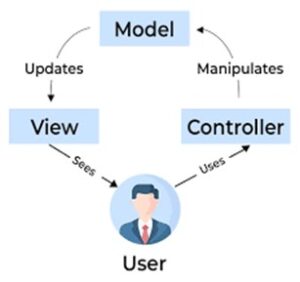
MVC architecture, short for Model-View-Controller, is a design pattern that separates an application into three interconnected components:
- Model – Handles data and business logic.
- View – Manages how data is presented to the user.
- Controller – Processes user input and updates the Model and View.
By keeping these responsibilities separate, MVC architecture promotes organized code, easier debugging, and more efficient collaboration among developers.
History of MVC Architecture :
The concept of MVC architecture originated in the 1970s with Trygve Reenskaug, who introduced it for use in Smalltalk applications. It quickly became a foundational pattern for GUI applications and, later, web applications. Over the years, it evolved and was adopted by modern frameworks like:
- ASP.NET MVC (Microsoft)
- Laravel (PHP)
- Django (Python)
- Ruby on Rails (Ruby)
Today, developers across all languages continue to use MVC architecture to maintain clean, scalable codebases.
Breaking Down the MVC Components
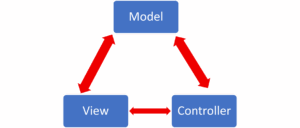
I. Model in MVC Architecture
The Model is the core of the application’s logic. It directly manages the data, rules, and logic of the application. It responds to requests from the controller and updates the data layer.
In MVC architecture, the Model:
- Represents the business rules and data.
- Communicates with the database (e.g., via ORM like Entity Framework).
- Does not interact with the UI directly.
II. View in MVC Architecture
The View is responsible for displaying the data provided by the Model in a user-friendly manner. It’s you the user interface of the application.
In MVC architecture, the View:
- Is made of HTML, CSS, and JavaScript in web development.
- Only presents data, it doesn’t process it.
- Changes when the Model data changes.
III. Controller in MVC Architecture
The Controller acts as an intermediary between the Model and the View. It processes incoming requests, calls model methods, and determines which view to display.
In MVC architecture, the Controller:
- Handles user input and interaction.
- Interprets the input and updates the Model accordingly.
- Selects the appropriate View for the response.
How MVC Architecture Works Together
- A user interacts with the application’s UI (View), like clicking a button.
- The Controller receives this input, processes it, and makes decisions.
- The Controller interacts with the Model to get or update data.
- Once the Model processes the data, the Controller selects a View to display the updated data.
- The View presents the data back to the user.
Advantages of Using MVC Architecture:
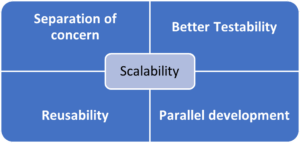
- Separation of Concerns-Each component has its distinct role, making the codebase cleaner and easier to manage.
- Better Testability-Since components are isolated; unit testing and debugging are much easier.
- Scalability-Large-scale projects benefit from MVC architecture because of its modularity and support for multiple developers working independently.
- Reusability-Views and Models can be reused across different Controllers or even projects.
- Parallel Development-Different team members can work on the Model, View, and Controller simultaneously without interfering with each other.
MVC Architecture in ASP.NET
ASP.NET MVC is one of the most popular frameworks implementing the MVC pattern.
- Model: Uses classes to represent application data and business logic.
- View: Uses Razor syntax to dynamically generate HTML based on model data.
- Controller: Handles HTTP requests, calls business logic, and returns a View or JSON.
ASP.NET MVC enhances the MVC architecture experience with built-in support for routing, authentication, filters, and more.
Use Cases of MVC Architecture
- Web Applications: Ideal for clean, responsive interfaces.
- Enterprise Apps: Large-scale systems benefit from its maintainability.
- Mobile Apps: Some mobile frameworks like iOS use MVC patterns.
- APIs: RESTful APIs can be built using MVC frameworks like ASP.NET Core MVC.
Best Practices in Implementing MVC Architecture
- Keep Controllers slim and shift business logic to Models or services.
- Avoid business logic in Views.
- Use View Models to pass specific data from Controller to View.
- Make Models reusable and testable.
- Use dependency injection in Controllers for better flexibility.
When followed properly, these practices elevate the performance and maintainability of any project built using MVC architecture.
Real-World Example of MVC Architecture
Let’s take a simple example: a Login Page in a web application.
- View: Displays the login form with fields for username and password.
- Controller: Receives the user’s input when they press “Login,” validates it, and sends it to the Model.
- Model: Checks the credentials in the database and returns whether the login is successful or not.
- Controller: Based on the result, the controller sends the user to a success or error View.
This modular flow makes it easier to update the login design (View), logic (Model), or flow (Controller) independently.
Frequently Asked Questions (FAQs)
- What is MVC architecture in simple terms?
MVC architecture is a design pattern that separates an application into three parts: Model (data), View (UI), and Controller (logic), making development cleaner and more organized. - Why is MVC architecture important in web development?
It improves maintainability, scalability, and code reusability, making it easier for developers to work on large-scale applications. - Is MVC architecture only used in ASP.NET?
MVC architecture is used across various technologies, including Java, Python (Django), PHP (Laravel), and JavaScript (Angular, though it follows MVVM more closely). - How does MVC improve application performance?
By separating concerns, developers can optimize each layer (UI, business logic, data) individually, leading to better performance. - Which programming language is best to implement MVC?
C# (with ASP.NET) is one of the best and most popular languages for implementing MVC architecture. - Does MVC architecture work with APIs?
Many RESTful APIs are developed using MVC-style frameworks like ASP.NET Core MVC. - Where can I learn MVC architecture with certification and placement?
Platforms like Marz Technology offer certified training programs in ASP.NET MVC with hands-on projects and 100% placement support, ideal for freshers and working professionals.
Social tagging: Advantages dot net course > Best Dot Net courses in Chennai > Dot Net MVCArchitecture > MVC Architecture > MVC Architecture Patterns
Recent Posts
Categories
- All
- Angularjs training in Chennai
- ASP.NET Core
- Dot Net Development Course
- dot net training
- dot net training in chennai
- dotnet full stack developer
- Free dotnet training
- information on dotnet
- Learn Java in chennai
- Learn Python at Karaikudi
- learn python online
- learn python online from chennai
- Linq Queries in .net
- mutual funds
- MVC Training Tutorials
- PHP Training in Chennai
- pmp training online
- power apps online training
- Python Training Online
- React Full Stack Development
- ReactJs
- share market
- Sharepoint framework online training
- SharePoint Freelancers in Chennai
- software testing
- spfx online training
- SQL Course Details
- Stock market
- Uncategorized