
REACT FULL STACK DEVELOPMENT
Introduction:
React and .NET online training offers industry-recognized certification that boosts your resume and job prospects. Through hands-on learning, you’ll build and deploy full-stack applications using React for the frontend and .NET for the backend. These real-world projects enhance your portfolio and showcase your practical skills. The training prepares you for roles such as Full Stack Developer, Software Engineer, or .NET Developer. It’s a powerful step toward career growth in today’s competitive tech job market.
What is React Full Stack Development:
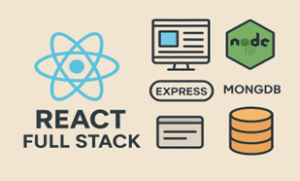
React Full Stack Development involves using React for building responsive and dynamic user interfaces on the frontend, while connecting it with powerful backend technologies like Node.js, Express.js, and MongoDB. This combination is commonly known as the MERN stack (MongoDB, Express, React, Node.js). Using React on the client side allows for fast, interactive interfaces, while Node.js handles server-side operations efficiently. Since both frontend and backend use JavaScript, developers benefit from a unified language throughout the entire application. This makes development faster, more consistent, and easier to manage, making React Full Stack Development a popular choice in the modern web ecosystem.
Why Choose React for Full Stack:
React is great for full stack development because it promotes the use of reusable components, which simplifies coding and improves project structure. One of the major advantages of React in full stack development is its strong ecosystem, including libraries like Redux, React Router, and development tools like Vite or Webpack. These tools make the development process smoother and more efficient. Additionally, React works seamlessly with REST APIs, allowing easy communication with backend services. This makes React full stack development ideal for building modern, scalable web applications that are fast, responsive, and easy to maintain using the JavaScript stack.
Frontend with React:
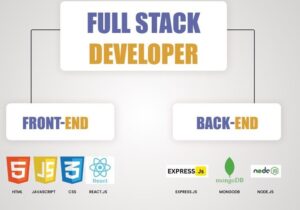
In full stack apps, React is ideal for building fast, responsive, and interactive frontends. React allows developers to create dynamic, real-time user interfaces without the need to reload the page. Features like JSX and the Virtual DOM make React efficient and easy to work with, enhancing the overall user experience. When used in full stack development, React ensures the frontend is smooth, flexible, and perfectly integrated with backend APIs, making it a top choice for modern web applications.
Backend Integration with React:
Even though React is primarily a frontend library, it integrates seamlessly with backend tools like Node.js and Express. In React full stack development, the frontend built with React communicates with the backend using HTTP requests, such as GET, POST, PUT, and DELETE, to fetch or update data from the server. The key advantage is that both React and backend technologies like Node.js use JavaScript, which makes the development process smoother and more consistent. This shared language simplifies data flow between client and server. As a result, react full stack development becomes efficient, fast, and developer-friendly for building modern web apps.
Database Connectivity in React Full Stack
In React Full Stack projects, databases like MongoDB are used to store and manage data, while React displays this data on the user interface through backend APIs. The backend, typically built with Node.js and Express, handles API requests, authentication, and session management. React fetches and updates data in real time, ensuring the UI stays in sync with the database. This setup allows for secure login, protected routes, and seamless user interactions in dynamic, data-driven applications.
Benefits of React Full Stack Development
React Full Stack Development brings several benefits. One of the biggest is that it allows developers to use a single programming language—JavaScript—across the entire stack. This makes development faster and less complex. React also promotes modularity, which helps in organizing code better. Additionally, full stack projects using React are highly scalable and suitable for enterprise-level applications. The real-time capabilities of React combined with powerful backend tools offer the best of both world.
Who can take React Full Stack Development
React Full Stack Training is ideal for:
- Engineering or IT students (like B.Tech/B.E in CSE, IT, AIML, etc.).
- Freshers preparing for job placements.
- Frontend developers learning backend skills.
- Backend developers who want to master React.js.
- Anyone who wants to become a Full Stack Developer.
No prior experience is needed—just basic HTML, CSS, and JavaScript knowledge is enough to get started.
Career Opportunities after React Full Stack Training
After completing your React Full Stack Training, you’ll be eligible for job roles like:
- React Developer.
- Full Stack Web Developer
- MERN Stack Developer
- Frontend Engineer
- Java Scripts Developer
- Software Engineer (Web)
Top Skills You Need for React Full Stack Development
To master React Full Stack Development, you need to learn React components, state management, routing, and backend tools like Express, MongoDB, and REST APIs. React Full Stack Development also requires Git, version control, deployment skills, and strong problem-solving abilities. Learning these essential skills will make your React Full Stack Development journey smoother and more rewarding.
Best Project Ideas for React Full Stack Development
Working on real projects is key to mastering React Full Stack Development. Popular project ideas include task managers, e-commerce platforms, social media apps, and job portals. These projects help you understand React Full Stack Development from database to UI. Building full stack apps gives you the confidence and portfolio to land your first job.
Frequently asked questions
- What is React Full Stack Development?
React Full Stack Development involves creating both the frontend and backend of web applications. React is used for the user interface, while Node.js, Express, and MongoDB handle backend logic and data storage. - What technologies are used in React Full Stack?
Common tools include React for frontend, Node.js and Express for backend processing, and MongoDB for database storage. These technologies work well together using JavaScript. - How does Express.js support backend development?
Express is a simple web framework built on Node.js. It makes it easier to manage routes, APIs, and server responses in a clean and organized way. - Why is MongoDB preferred in full stack development?
MongoDB is a NoSQL database that stores data in a flexible, JSON-like format. It fits perfectly with JavaScript and works smoothly with Node.js applications. - Can I use MySQL instead of MongoDB?
Yes, you can use MySQL, which is a relational database. However, MongoDB is often preferred in JavaScript-based projects for its simplicity and speed. - Is learning only React enough for a job?
React alone is good for frontend roles, but full stack knowledge makes you more competitive. It opens up opportunities to work on complete web solutions.
Recent Posts
Categories
- All
- Angularjs training in Chennai
- ASP.NET Core
- Dot Net Development Course
- dot net training
- dot net training in chennai
- dotnet full stack developer
- Free dotnet training
- information on dotnet
- Learn Java in chennai
- Learn Python at Karaikudi
- learn python online
- learn python online from chennai
- Linq Queries in .net
- mutual funds
- MVC Training Tutorials
- PHP Training in Chennai
- pmp training online
- power apps online training
- Python Training Online
- React Full Stack Development
- ReactJs
- share market
- Sharepoint framework online training
- SharePoint Freelancers in Chennai
- software testing
- spfx online training
- SQL Course Details
- Stock market
- Uncategorized